

Reviews
TARNANTHI LAYERS
Dear Reader,
Adelaide is hosting the inaugural indigenous arts festival called TARNANTHI. Our galleries and streets have been filled with exciting art and the presence of Aboriginal people networking. I’m overwhelmed by the diversity of artworks that offer a depth of ideas encompassing politics, our environment, the Dreaming, identity and social spheres. So far I’ve only got to see a very small amount of what’s on and I need the time to digest the ideas on offer. I want to share my considerations on three works that have really inspired me. All works discussed here are on show at the Art Gallery of South Australia
Firstly, to the watercolour artists from Hermannsburg in the Western Desert of Australia, who are all relatives of Albert Namatjira. Namatjira showed white Australia a unique vision of the desert filled with light, rhythm and vivid colour. The public recognition that Namatjira received for painting in a western tradition, clashed with the discrimination that all Aboriginal people faced, and created difficulties for him in his community. You can read more about Namatjira’s difficult life as a painter walking between two cultures here https://en.m.wikipedia.org/wiki/Albert_Namatjira.

This watercolour painting is on paper and is of MOUNT GILES, Northern Territory.
Artist: Hubert PAREROULTJA b.1952, Hermannsburg, N.T.
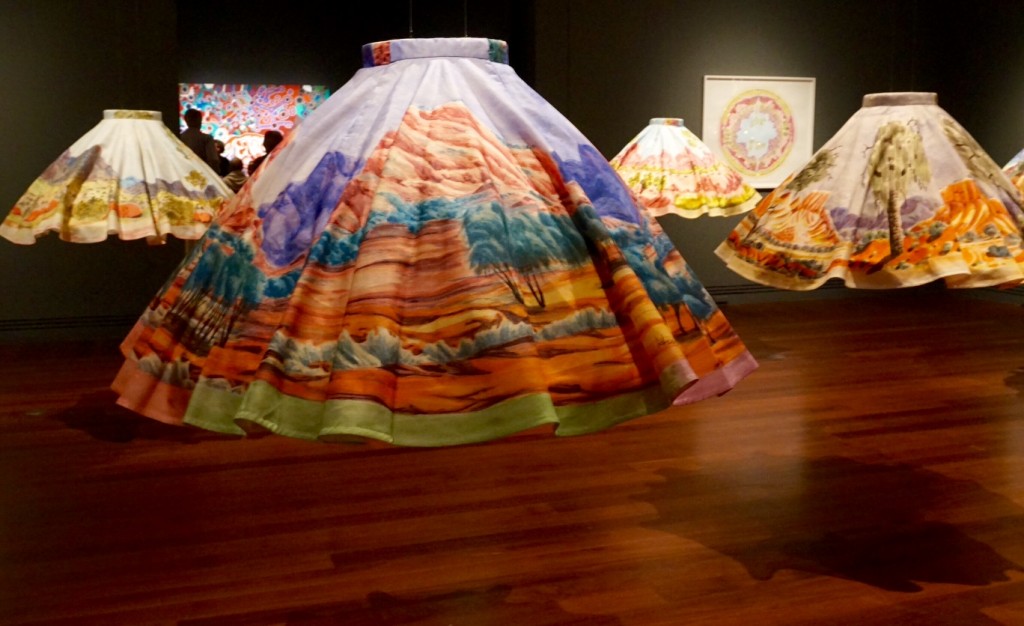
The Hermansburg artists continue to paint after Namatjira’s legacy. In this exhibition they have chosen to paint panoramas within a circle. These works were inspired by the circling flight of a butterfly’s journey in the desert. Reminiscent of mandalas, the watercolours have then been printed on 1950’s style skirts that amplify the sense of an undulating flow of a butterfly careering through the desert. They evoke a sense of lightness, both visually and in terms of weight. These watercolours have been transformed into a wearable object that locates the wearer in the centre of a mandala or the centre of the desert. Significantly, Namatjira was the first aboriginal artist to win the Archibald Prize for portraiture in 1957 and the skirts honour his sensibility as a watercolour artist. Like many Aboriginal artists, Identity and country were intertwined for Namatjira and he considered his landscapes to be portraits.
Secondly, I was intrigued by Western Cape York artist Mavis Ngallametta (b. 1944, Kendall River, Queensland), who paints her country of wetland river systems and coastlines. She has depicted her country through her experience of multiple perspectives. These perspectives range from a birds eye view point in a helicopter that is surveying the wetlands below, to walking barefoot through her country. She uses natural ochres from that country as well as acrylic paints to capture a sense of abundant energy that is flowing.

Painting: Draging net at Less Creek, 2014, Aurukun, Queensland.
Natural ochres, synthetic polymer paint and charcoal on linen.
I love that the natural pigments on the canvas have been trodden with her feet, and that she integrates two viewpoints; one from above, and one through her human tactile body experience. I say this because it appears that her experience is not entirely visual. Mavis began her art practice through weaving. I think this is apparent in how her painting marks have constructed an image, as well as the way in which she has woven together different viewpoints. Viewpoints of experiences that are visual, tactile or a felt sense, as well as in movement. The energy in this painting speaks of the energy in nature and an abundance of life. Her ancestors and Dreaming infuse everyday existence. Layers of time are present in a moment. What she presents is deeply sensory and human, as well as transpersonal.
Lastly, Karen Mills is an artist using the practice of painting to reconnect to land, history and spirituality. Her media includes natural ochre and dry pigment. She is concerned with the surface of the canvas while using layers of paint as a metaphor for layers of Australian history and geology. As a painter, I was intrigued by these mysterious surfaces and wondered ‘what is hidden and what is emerging’? Sometimes the surface is like a thin veil over deeper terrestrial movements. Sometimes the surface cracks open to expose a dark chasm. These little glimpses into geological and earth dreamings are also a metaphor for Australia’s political history of colonisation. Spaces momentarily open up and close again as the veil thickens. When I look into this painting and allow it to suggest itself to me, I get a sense of time, space, geology, history and our human lives lived. These paintings present a big view of existence in constant flux.

Karen Mills, b.1960, Katherine, Northern Territory
Untitled painting from the Terrain Series, 2015.
Friend, I feel I have given you just a little glimpse through a crack in this moment in time of what is on offer here in Adelaide. Our aboriginal sisters and brothers have such a richness to offer and I feel privileged to have been a witness to this event. I hope you have enjoyed this sharing. Thanks to Nici Cumpston for curating this festival.
Click on the link below to go to my website and leave a comment on my blog page. You can also sign up for my blog/ newsletter there. Feel free to share this post with anyone who it may interest.
http://lynnlobo.com/blog/


Related posts
Reviews, Studio Musings
VERMEER’S QUIET TENSION
This post is a review of the Vermeer exhibition at the Rijk Museum in 2023.
Reviews
SOROLLA’S HOUSE- an Extended Postcard
Hi, Sit down with a tea and get comfortable because this is a long one….
Reviews
Journey into DIVIDED WORLDS
Hi, Mad March is over in Adelaide and we had a really fantastic festival. I…
Reviews, Studio Musings
SHRINE 5 – IMAGINE
Dear Reader, I love imagining things. Imagination is a gift of nature and essential for…
Leave a reply
You must be logged in to post a comment.