

Reviews, Studio Musings
VERMEER’S QUIET TENSION
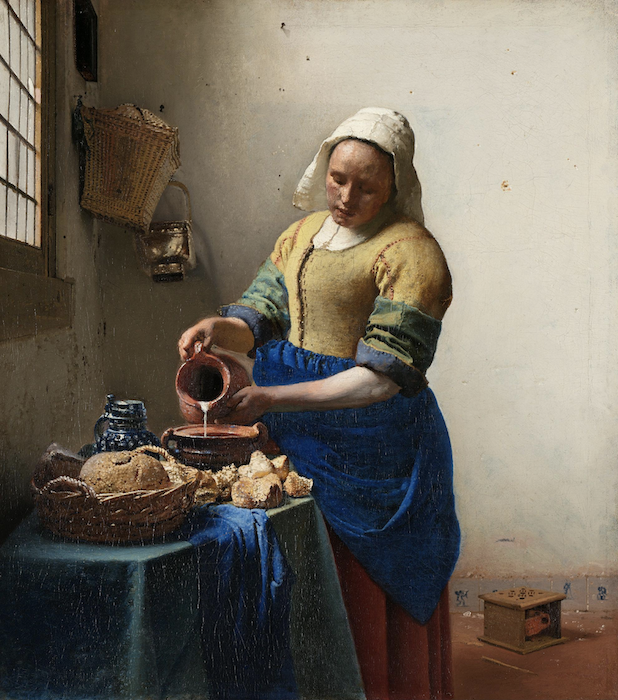
Above: The Milkmaid – Johannes Vermeer
Vermeer has always been one of my most favourite painters. I couldn’t believe my luck when I found out that the Rijkmuseum in Amsterdam, was hosting the largest exhibition of Vermeer’s paintings held to date, and it was on after my residency in Finland.
Most striking to me is the quietness in his paintings. Vermeer is best known for his interior domestic scenes of people in thought or in private interactions.
Johannes Vermeer was born in Delft in 1632 and lived for 43years. He grew up looking at art because his father was an art dealer. As a young man Vermeer painted larger works to establish himself as a painter. His paintings grew smaller in size as he matured. He is known to have painted around 37 paintings.
The Rijkmuseum has presented 27 of Vermeer’s works here, on loan from institutions and private collections worldwide. I’m in awe of the logistics behind coordinating such an exhibition. Each large room held 3-5 small paintings. Works were presented thematically as curators were trying to show how Vermeer ‘introduces the outside world into his stilled scenes’. The exhibition was sold out and numbers were limited, making viewing comfortable. It took about 3 hours to take in the exhibition, with a coffee break in between.
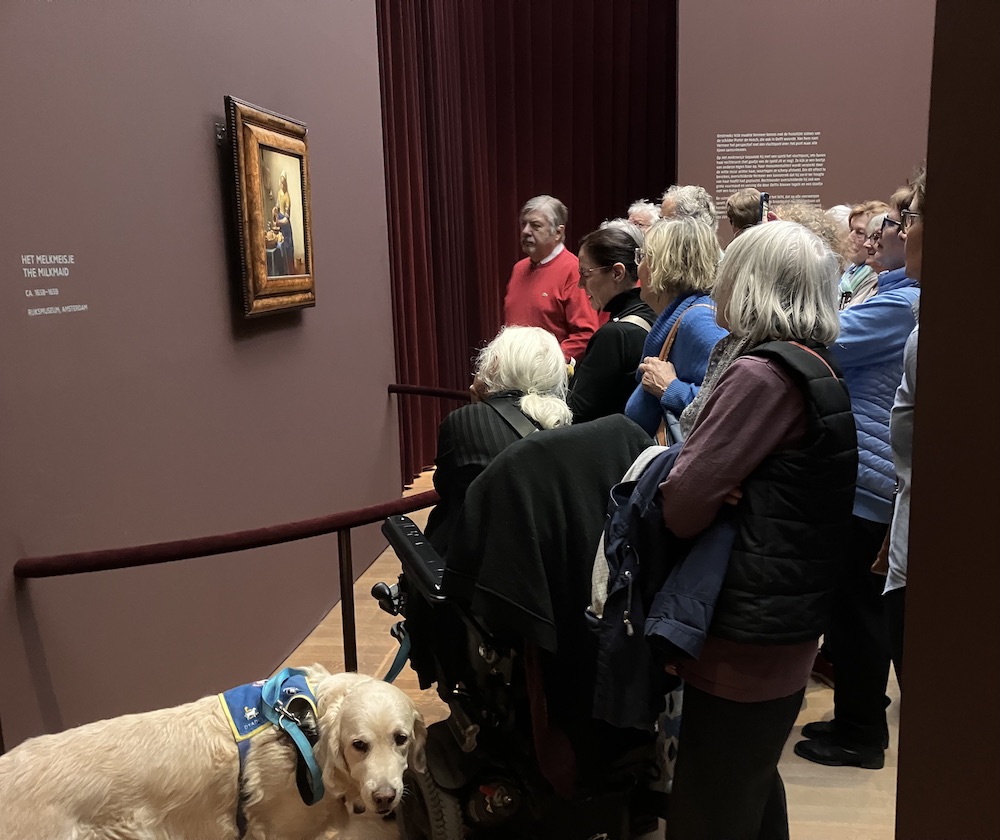
Around 1655 Vermeer became aware of the domestic scenes of Pieter de Hooch, a contemporary of his. de Hooch used single point perspective (where all lines converge into a single vanishing point). Vermeer made use of this observation by placing a pin in his canvas that acted as a vanishing point and attaching a string to it to obtain lines of convergence.
A subtle glowing light bathes Vermeer’s contemplative interiors. Notice in the featured image titled The Milkmaid, how the bread and basket on the table glow. That section is painted with hundreds of dabs of coloured paint to create light and texture. Our eye fuses this experience to read as bread.
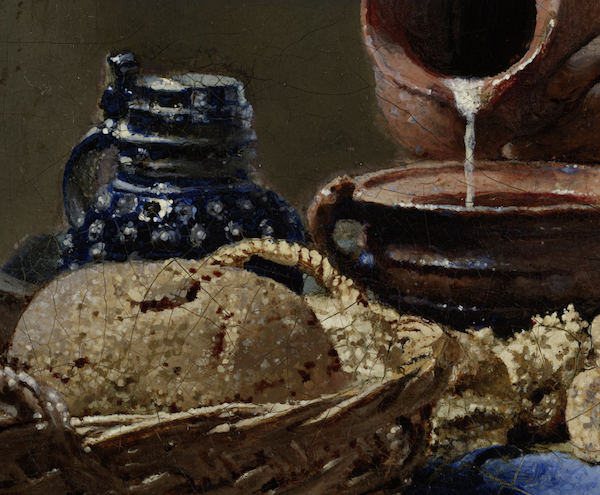
Detail from The Milkmaid
Vermeer’s interiors are invented and highly choreographed. While figures are posed in a scene, Vermeer uses the light/dark pattern of the painting to direct our gaze into the area he wants us to focus on.
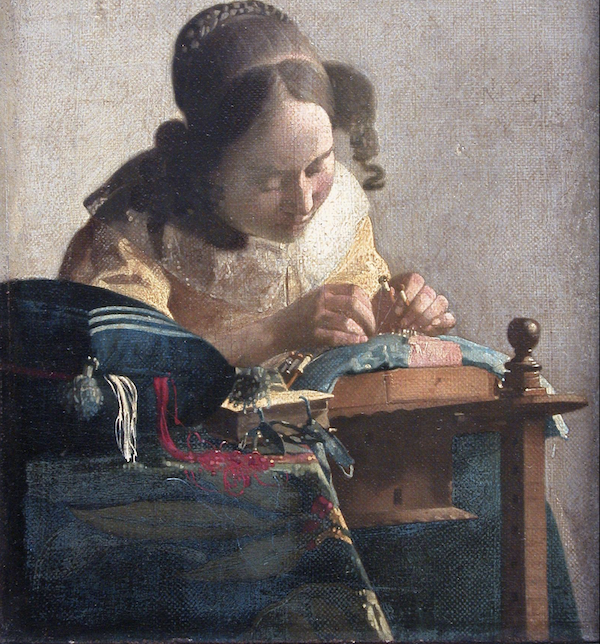
The Lacemaker
The Lacemaker is a composition that highlights a woman engrossed in a delicate act of making lace. Starting at the bottom of the picture, we have access to what the woman is doing via the light catching the edge of the tablecloth. The light leads us to a horizontal platform where her hands are at work. Our eye is held within a triangle of light. The round, dark knob on the right that is sharply in focus acts like a full stop, and prevents our eye from drifting off the canvas. We follow the edge of her knuckles and sleeve back to her face. The triangle of light creates an intimacy. The soft edge transitions in the shapes that make up the woman’s hands, give a sense of them in movement. Her hands, lace and lacemaking are one. Vermeer never forgets his viewer. We are given a privileged view of a woman engrossed in a private world.
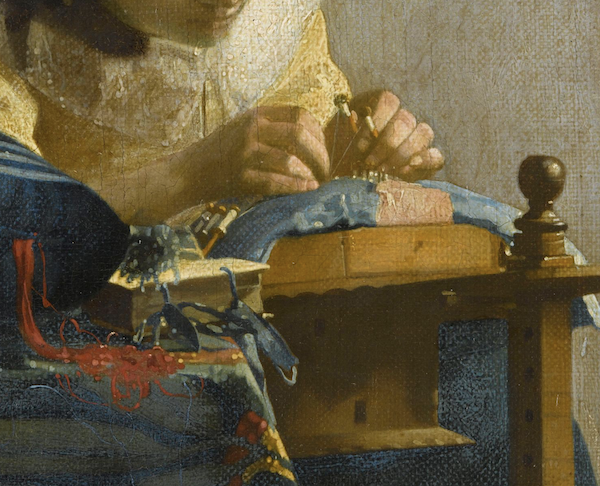
Detail of The Lacemaker
The smoothness of Vermeer’s brushwork while simply painting shapes give his paintings an uncluttered, clean look. Our eye does not stumble on brush marks. Vermeer uses this strategy, along with his mastery of edges to hold our eye where he wants us to look. In a painting, edges exist between one colour shape and the next. An edge can be hard, soft (blurry), or blended so that no line exists. Go ahead and take a closer look at the edges between colours in the painting.
Everything is significant and related within the scene. Yet Vermeer paints questions. As a viewer, we are given information that leaves us wondering. Narratives are implied as we are invited to make connections.
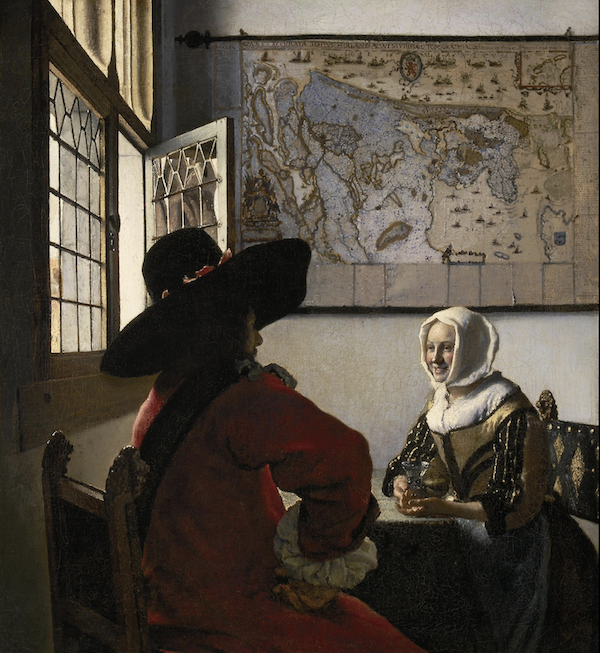
The Officer and Young Woman
In the painting Officer and Young Woman, the officer has his back to us and sits in the dark foreground. He is an imposing shape with his hand on his hip, and he is much larger than the young woman. While this size difference creates a sense of space, I am also aware of his power and rank in relation to her. He doesn’t remove his hat and we don’t see his identity. Rather, we feel his presence.
Once again Vermeer directs our eye past him and into the light filled middle ground. The young woman eagerly sits forward, smiling and holding a wine glass. Does the officer have a drink too? The young woman’s other hand is upturned in a gesture that suggests openness, perhaps submission, or both. A window opens to the world outside, like an opportunity, but for what? In the background hangs a map in colour of distant places. The ambiguity that Vermeer sets up suggests a complex relationship filled with plans, hopes, dreams and relationship dynamics that these people may not be aware of.
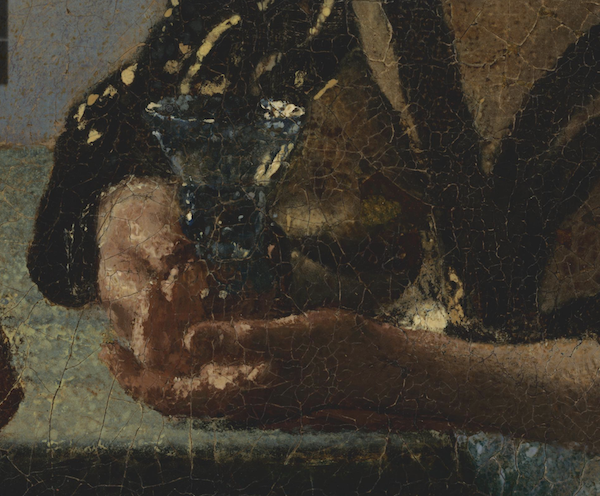
Detail of The Officer and Young Woman
What I love about Vermeer’s paintings is the way he composes his scenes to create ambiguous narratives, and he does it all with light and paint. He directs our imaginative eye into a quiet tension. The drama is subtle and implied, as we wonder about the people in his paintings. Much is understated. We slowly take in the quiet, private moment.
Through my musings, I hope I’ve given you an insight into how I as a painter, look at Vermeer’s paintings. I suggest you take the time to look at just one of Vermeer’s painting that catches your interest. Below is a link to the entire exhibition online. Ask yourself, “how and why does this painting hold my attention? What is the painter doing here?” The online tour with Stephen Fry is a treat.
Click here for VERMEER AT THE RIJK MUSEUM
Thanks for reading my post and leave me a comment if you are moved.

Related posts
Studio Musings
THE PATHLESS PATH – AN INVITATION
A reflection on the parallel between the process of painting and hiking or bushwalking
Studio Musings
PRESENCE
I’ve been thinking about PRESENCE lately. What does the word mean? This post explores the wholeness of presence.
Art News, Studio Musings
FINLAND RESIDENCY REFLECTIONS
I have been considering how the artist residency at Arteles Creative Centre is set up to maximise the possibility for entering a flow state.
Art News, Studio Musings
SNOW STUDY- A Letter from Finland
Featured Image: A view from the shed – gouache study on paper Now into the…
Art News, Studio Musings
ON SILENCE
Silence is as much an inner condition as it is an outer environment. We can feel grounded and silent in a noisy atmosphere, or feel disturbed in an eerily quiet place. . .
Leave a reply
You must be logged in to post a comment.